
WW Q&A #29
A couple Bub’s Honey supporters and customers sent me a Facebook chainmail link listing many wondrous things about honeybees. One of the claims that caught my scientific eye was this: “Did you know that honey contains live enzymes? Did you know that in contact with a metal spoon, these enzymes die? The best way to eat honey is with a wooden spoon; if you can't find one, use a plastic spoon.”
I wanted to check this one out a little further and it led me to some fascinating territory that, it turns out, I’ve been wanting to dive into for some time: The world of enzymes and invertase and how bees make honey. Let’s check it out!
First, here is a great little article about the question of whether or not to use a metal spoon. The upshot is, if you’re using stainless steel flatware, and you don’t leave the spoon in the honey, it’s fine. A copper spoon might corrode and make the honey taste bad. But I do happen to think that those lovely wooden honey dippers are one of the most elegant ways to put some honey on your toast, so get yourself one of those (I need to put that on my birthday list myself!).
The reason for the concern about metal spoons, however, leads to the mention of enzymes. You may remember from chemistry class that enzymes are important to all biological life, that there are many, many kinds of enzymes, and that they are catalysts that facilitate a chemical change (but they themselves are not consumed in the chemical reaction).
Honeybees make saliva that is composed of a number of enzymes, an important one of which is called "invertase" (enzymes in biochemistry have the “-ase” ending in their nomenclature. The main enzymes in human saliva are called “amylase” and “lingual lipase”).
A little further chemistry lesson here: invertase is an enzyme that allows a complex sugar (sometimes also known as a disaccharide) to be "broken up" into simpler sugars. So, case in point important to the honeybee-flower reciprocal relationship: flower nectar contains the disaccharide sucrose (the same kind of sugar as regular white table sugar). The invertase in the bee's saliva transforms sucrose into two simpler sugars, fructose and glucose.
This chemical reaction is often called "hydrolysis," so called because it requires the presence of water (“hydro” means “water” in the Greek language). In fact, water is required as part of the reaction. So, it's not just sucrose that is transformed, some water disappears too in the creation of the two sugars. The chemical components of the water (hydrogen and oxygen) become components of the new simpler sugars. We can write a chemical reaction equation that looks like this (without all the symbology that often scares people:
sucrose + water (in the presence of invertase, which is not transformed) yields glucose + fructose (and the water is gone!)
The bees’ invertase thus accomplishes at least two beneficial transformations at once: converting a complex carbohydrate into two simpler ones that the bee (and humans) can digest, and removing water from the nectar. The bee is actually making more sugar out of water!
How this happens in practice is that the honeybee draws nectar into a special "honey crop", an inner chamber which is not the bee's true stomach. The invertase is added to the nectar within the crop and the chemical transformation begins. But it doesn't end there. The returning forager bee (who is among the oldest of the workers) meets another (younger) worker and transfers the transforming nectar to her, (and then goes right back to foraging). The receiving bee sips the nectar out of the delivering bee’s crop with her long tongue just as the forager first sipped the nectar from the base of the flower. This bee will bring the nectar into the hive. In the process more invertase is added, more sugar transformation occurs, and more water is chemically transformed. More passing happens to more bees in a "bucket brigade", or a "crop brigade". It’s not nearly as simple as a linear transfer, however. There is passing of nectar every which way in the hive. A fascinating article I found described an experiment done in 1952 where they gave sugar water to bees that was marked with a radioactive isotope. They were then able to detect how quickly the radioactive “nectar” was disbursed through the hive. Here are the astounding results: “Within 3.5 hours after releasing just six foragers that were fed 32P labeled sugar water into a colony, most of the other foragers (62%) and about a fifth of the worker population in the brood area received some of the labeled food.“
Wow, so there is an incredible amount of transference and collective digestion taking place with every sip of nectar that comes into the hive!
The nectar keeps transforming more and more to honey, and each time it is passed it becomes more sugary as more water is transformed into the simpler sugars. By the time the last worker bee deposits the sugary solution into a cell for storage, the nectar has gone from perhaps 90% water to 20%!
Even then it's still not quite honey yet and the workers collaboratively move air currents through the hive using their wings to further dehydrate it until it is precisely 18% water content (how they know when it’s “ready” is another of those mysterious unanswerable questions!). When the cell is full to the brim with transformed honey, the bees build a wax cap to seal it up until it is needed.
So, another claim made in the FB post was that the honey is already digested. From what I've described we can see that this is certainly true! The collective digestion of the bees transforms a colorless, watery nectar that is only a tiny bit sweet into a rich, sugary, golden viscous sticky fluid. When we eat honey, we are eating a flower food that has been entirely transformed into a complex mixture of simple sugars, enzymes, pollen and amino acids (we’ll have to get to those amino acids in another post)!
Some people like to say that this means we are eating "bee spit" when we eat honey. While not altogether true, it's not completely false either. If this makes you queasy, consider that we routinely also drink milk made from a cow's udders, and eggs created within the body of a hen. So, a little bee saliva should not be a big deal!
Invertase is found in many living things and processes in nature. One important place is in yeasts. When baking bread or making beer, the yeasts (which are a fungus) have a similar ability to the bees to transform dough into bread and wort into beer.
This means that what the bees do with transforming nectar into honey has some similarity to a fermentation process. This should make it not surprising that bees can actually take the fermentation process further if they want to. Bees themselves know how to continue into a second fermentation by mixing pollen with the honey to make bee bread. I previously described this process here in WW Q&A #14.
The process by which bees take flower nectar with just a little sucrose and turn it into delicious honey should make us all feel some real awe!
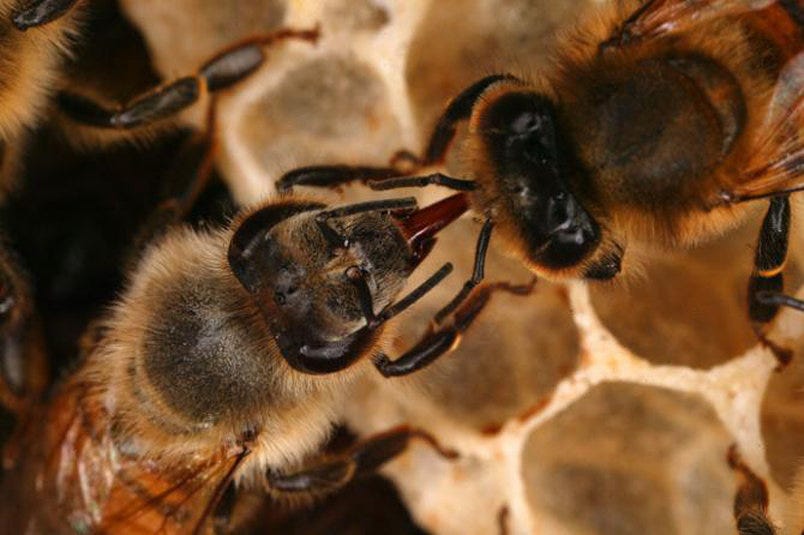
Photo source here