
Another Projective Geometry Lesson, With a Considerable Preamble:
PART I: You Are Here
I am a big fan of the Hitchhiker’s Guide To the Galaxy series of books, and a number of scenes and moments are pretty much ingrained in my psyche at this point in my life.
One such scene is the time when Zaphod Beeblebrox, a galactically infamous “cool guy” is captured and thrown into a torture device called the Total Perspective Vortex (TPV). Here is a Hitchhiker’s fan page that gives the background on the TPV, and here is a short excerpt:
The idea is that, if every atom of the universe is affected by every other atom of the universe, then it is theoretically possible to extrapolate a model of the entire universe using any single piece of matter as a starting point. The Vortex does this employing a piece of fairy cake as its base of extrapolation.
The prospective victim of the TPV is placed within a small chamber wherein is displayed a model of the entire universe - together with a microscopic dot on a microscopic dot bearing the legend “you are here.” The sense of perspective thereby conveyed destroys the victim’s mind.
As Zaphod is placed into the TPV and it is activated, the reader believes that our hero is about to have his mind turned into goo by showing him how totally insignificant he is in the vast eternity of space and time. But, in a fun plot twist, it turns out that all this time, Zaphod has been in a simulated universe that was created only for him. He strolls cheerfully and languidly out of his session in the TPV machine saying that it showed him exactly what he expected: that he was, in fact the “single most important person in the universe” and one fabulously awesome guy, man.
This funny plot device is, of course, an exploration of just how egotistical and self-centered humans can be. Douglas Adams had an amazing knack for marrying illustrations of human quirks with current science fiction tropes to make us laugh about things that we might otherwise take too seriously. Case in point: It’s common practice for proponents of materialism today to locate a semblance of humility into an idea quite similar to that of the Total Perspective Vortex. One thinks of the quite beautiful and moving words of Carl Sagan about the Pale Blue Dot of our Earth when the photograph (suggested by Sagan to the NASA engineers) came back from the Voyager I Spacecraft in 1990. The spacecraft had left Earth in 1977 and was about to drift into the outer reaches of our solar system. It turned its camera around to take a photograph of Earth from out there, and beamed it back to us:
Look again at that dot. That’s here. That’s home. That’s us. On it everyone you love, everyone you know, everyone you ever heard of, every human being who ever was, lived out their lives. The aggregate of our joy and suffering, thousands of confident religions, ideologies, and economic doctrines, every hunter and forager, every hero and coward, every creator and destroyer of civilization, every king and peasant, every young couple in love, every mother and father, hopeful child, inventor and explorer, every teacher of morals, every corrupt politician, every “superstar,” every “supreme leader,” every saint and sinner in the history of our species lived there--on a mote of dust suspended in a sunbeam.
The quotation continues and you can read it in full here. Here is how it ends, and I must say that I respect and admire Carl Sagan for his own personal humility when he says:
To me, it underscores our responsibility to deal more kindly with one another, and to preserve and cherish the pale blue dot, the only home we’ve ever known.1
Amen to that. However, in what to me is a strange twist, many people, considering the very same facts, turn the moral on its head and say: “This proves that we must learn how to get off this planet and colonize others, so the human race can expand across the universe, conquer it, and we won’t be wiped out before the worst happens to our Earth.”
I’ve been recently reading the weird & fascinating space trilogy by C.S. Lewis, and the character Weston is an exact representative of this megalomaniacal viewpoint.2
You might ask at this juncture: “What does this have to do with Projective Geometry?” Well, perhaps it’s obvious that each of these examples is playing with the notion of actual or metaphysical perspective. Is it possible to take up a perspective other than our own? Can an individual shift their perspective, or have it shifted for them? Can two people regarding the same fact from the same perspective (for example the Pale Blue Dot of Earth photographed from far, far away) come to entirely opposed viewpoints (“Cherish and Preserve our Earth”, or “Use Earth Up to Get Free of Earth”)?
These opposed viewpoints exemplify a huge difference of perspective that I wrestled with when I first encountered anthroposophy. Materialistic science in Steiner’s time was painting the human being into ever-dwindling insignificance and narrating a mechanistic, deterministic and dispassionate universe that was mostly empty space and didn’t give a fig for the human beings that had been accidentally created on one Pale Blue Dot. In the time since Steiner, this has only intensified, at least in the dominant channels of discussion. It became a litmus test of who was enlightened and who was not to say that, if you thought the human being to be important in the least, you were a deluded anthropomorphic religionist who had your head in the sand and refused to accept the Total Perspective that cosmological physics was painting.
Bucking this trend entirely, Steiner boldly claimed, kind of like Zaphod Beeblebrox, that humans and all living things were, in fact, cosmically important, cosmically connected and entirely central to a true understanding of the universe.
Indoctrinated as I was to the modern worldview, I remember being repelled by this when I first understood it. What hubris! Hadn’t we shown that placing the human being at the center led to the many tyrannical wars that Sagan decries? Isn’t what we needed right now to be downgraded, not elevated? Religions through time had claimed that God was not only transcendent but also imminent, involved and interested in the affairs of humans…but science, or the culture that grew up around science, rejected this notion as unnecessary at best and backward and primitive at worst.
The centrality of the human being was not part of the new materialistic theories of physics, and many folks, sensing a kind of newfound freedom, said “good riddance”. Could we, as Sagan implies, enter a new era of humility by realizing how physically small and insignificant we are? Well, apparently not. The 20th century is proof enough that it wasn’t organized religious belief per se that was driving our hubris. Or said another way, if you discard one religious path or belief, you will just pick up another one, probably deluded by your intellect that it is something different and better. Communism, capitalism, and materialism are all modern vessels for life-destroying hubris on a scale never before imagined in previous generations.
As I got to know and explore Steiner’s thinking I realized that, paradoxically, it may be that only by placing the human being “back at the center” again can we ever escape our experiments in destruction, vacuousness, loneliness and materialistic idolatry. After all there are other facts to consider beyond just the Pale Blue Dot: The human brain in its structure and complexity mirrors the observable complexity and mystery of the universe itself with its billions of neurons, uncountable interconnections, ever-more-thoroughly-demonstrated plasticity and untapped ability. And, one can’t argue with this simple fact, which is essentially the very same notion that Sagan is invoking but looking at it the other way around: that human beings, throughout our evolution have, in fact, done all of our evolving, thinking, loving, warring, feeling, fighting, building, seeing and sensing, right here, right under the Sun, Moon, planets and dome of stars that are always apparent to and present to us as the days and nights swing on by.
So, while it is certainly true that there is nothing apparently special about our physical location in the galaxy or the universe (Douglas Adams says in the excellent first line of Hitchhiker’s Guide: “Far out in the uncharted backwaters of the unfashionable end of the Western Spiral arm of the galaxy lies a small unregarded yellow sun”), it is equally true that every part of our human bodies, and every part of our human souls, grew here, lives here, takes its sustenance here, learned to speak, think, wonder and discover here, and continues to be enlivened here.
Leaving aside for now the question of whether humans could ever find another planet to live on and whether life there could be liveable, one must ask, “But even if we could physically move to another planet, would not everything about us then transform in response to that change in location and perspective? And would we not then simply be an entirely new kind of being in an entirely new world?” C.S. Lewis (who was part of the Inklings that included Owen Barfield & J.R.R Tolkien) has an angel of sorts ask this very question of Weston in the second of his aforementioned space trilogy books.
These are philosophical musings, but they are leading to the reasoning for why I feel so motivated to bring Projective Geometry to you:
This is because one could extend everything I’m saying not only to humans, but also to the animals, plants and every other living thing on Earth. If you place the human being, yourself, back into the center of things, not in an egotistical way, but in the obvious way in which one realizes that the only perspective you can actually hold is your own and that “Wherever you go, there you are”... if you do this, you may suddenly be struck by the fact that the entire universe is actually affecting us all, and has always been. Just because we have modern notions about the physical bigness of Space does not mean that all of those twinkling stars and galaxies out there are not speaking to us, right now, and have not always been, for all of human time. Despite our modern notions of space that make it all seem so remote, vast, empty, and mechanical, the starry heavens have been and remain an imminent phenomena that we can easily witness any night we care to walk outside. They have been along for the ride with us from the beginning and they will always be so. Only in the last 150 years of ubiquitous electric lighting has it been possible for many of us to forget this by blotting it out with our own substitute illuminations. The heavens are part of us, participated in forming and shaping us, and continue to do so. But in what I now see as a weird bit of mental gymnastics, at our current stage of intellect, we imagine that those very stars must be “just too far away” for us to have any meaningful connection to them.
The current hubris of materialism says, “Space is really Big and we are small by comparison, and so there is no possible way that anything Out There can affect us in any significant way… except maybe it has planets we could colonize in case we use this one up. We are truly isolated and really alone. We are accidentally conscious Ghosts in a Great Machine.”
But…as soon as you say this, (and on your way to total despair), if you tenaciously hang in with this line of thinking, all of a sudden you realize, “Wait a second, it was me who thought all of those thoughts, and where did those thoughts come from when they came to me? Where did I get the ability to perceive and contemplate the vastness of space and the smallness of Earth in the first place? Why am I arbitrarily cutting off my connection to the stars, when it may have been the stars themselves and their speaking to human beings that have led us to these contemplations?
From all of this, I suggest to you that the Universe isn’t actually nearly as big as we think if you can let go of your materialistic idols, that Steiner and Zaphod were essentially correct (although Zaphod was really quite full of himself), that humans are really and truly important, that we are intrinsically connected to our Pale Blue Dot, children of it in fact, but we are also connected to Everything Else . . . and that all of the Universe is actually and really an active player in our world.
And this leads me to a really significant element of Projective Geometry called “The Fundamental Theorem”. You don’t call something Fundamental unless you think it undergirds everything else right? I will give it the playful alias, a Proof that Everything in Space is No More than Two Steps Away.
And it will be coming out in exactly one day in PART II. Try to find where you stashed your straightedge, paper, pencils and get ready to draw and ponder if you’d like to come along with me!
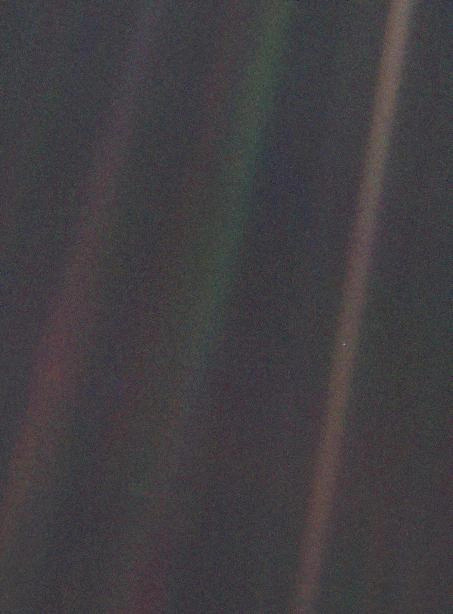
Can you see the Pale Blue Dot? It’s toward the right, about 3/5 of the way down the rightmost sunbeam.
I also want to say that, writing this, I have just now made a connection between Sagan’s comment and the allegorical tale by Dr. Seuss, Horton Hears a Who. I wonder if Seuss was inspired by Sagan’s idea of an entire world of people living in a speck of dust? Hmmmm…
Here is a website with choice quotations from Out of the Silent Planet. https://universeofdahee.com/2023/08/24/out-of-the-silent-planet-c-s-lewis/ And here is one such quotation from Weston. As crazy as he sounds in this book, and as ruthless, he represents a pretty common point of view among people today…that we should use Earth up and develop technologies to get free of Earth, so we can colonize the universe.
“It is in her right,” said Weston, “the right, or, if you will, the might of Life herself, that I am prepared without flinching to plant the flag of man on the soil of Malacandra: to march on, step by step, superseding, where necessary, the lower forms of life that we find, claiming planet after planet, system after system, till our posterity—whatever strange form and yet unguessed mentality they have assumed—dwell in the universe wherever the universe is habitable.”